Milescraft DrillMate Portable Drill Guide Adjustable Precision Drilling Jig Review
A look at the Milescraft DrillMate portable drill guide: 45/60/75/90 degree locks, self-centering base, and who it actually suits.
The Milescraft DrillMate Portable Drill Guide Adjustable Precision Drilling Jig is worth buying if you own a 3/8″ or 1/2″ cordless drill and need repeatable straight holes without owning a drill press. Four locking angles, 45, 60, 75 and 90 degrees, plus a depth stop. Skip it if you already have a bench press.
As an Amazon Associate I earn from qualifying purchases.
How this review was made: written from my own video review of this product. Every opinion here is my own, from using it myself.
Quick Verdict
Four locking angles, a 3″ self-centering base, and a chuck that takes any 3/8″ or 1/2″ cordless drill. That’s a drill press for people who don’t have room for a drill press. The trade-off is obvious: you’re still the one holding it steady.
Buy if you:
- Need dozens of identical, evenly spaced holes in one project
- Own a 3/8″ or 1/2″ cordless drill already
- Drill into round stock like dowels or closet rod
- Have no floor space for a stationary press
Skip if you:
- Want angles other than 45, 60, 75 or 90 degrees, since those four are the only locking positions
- Already own a bench-top drill press
- Need to drill round stock over 3″ in diameter
| Drill compatibility | 3/8″ and 1/2″ cordless drills |
|---|---|
| Chuck | 3/8″ capacity, key included |
| Angle settings | 45°, 60°, 75°, 90° (each locks) |
| Round stock capacity | Up to 3″ diameter, self-centering |
| Mounting | Rubber feet removable for custom jigs |
98 holes is the number that makes this make sense
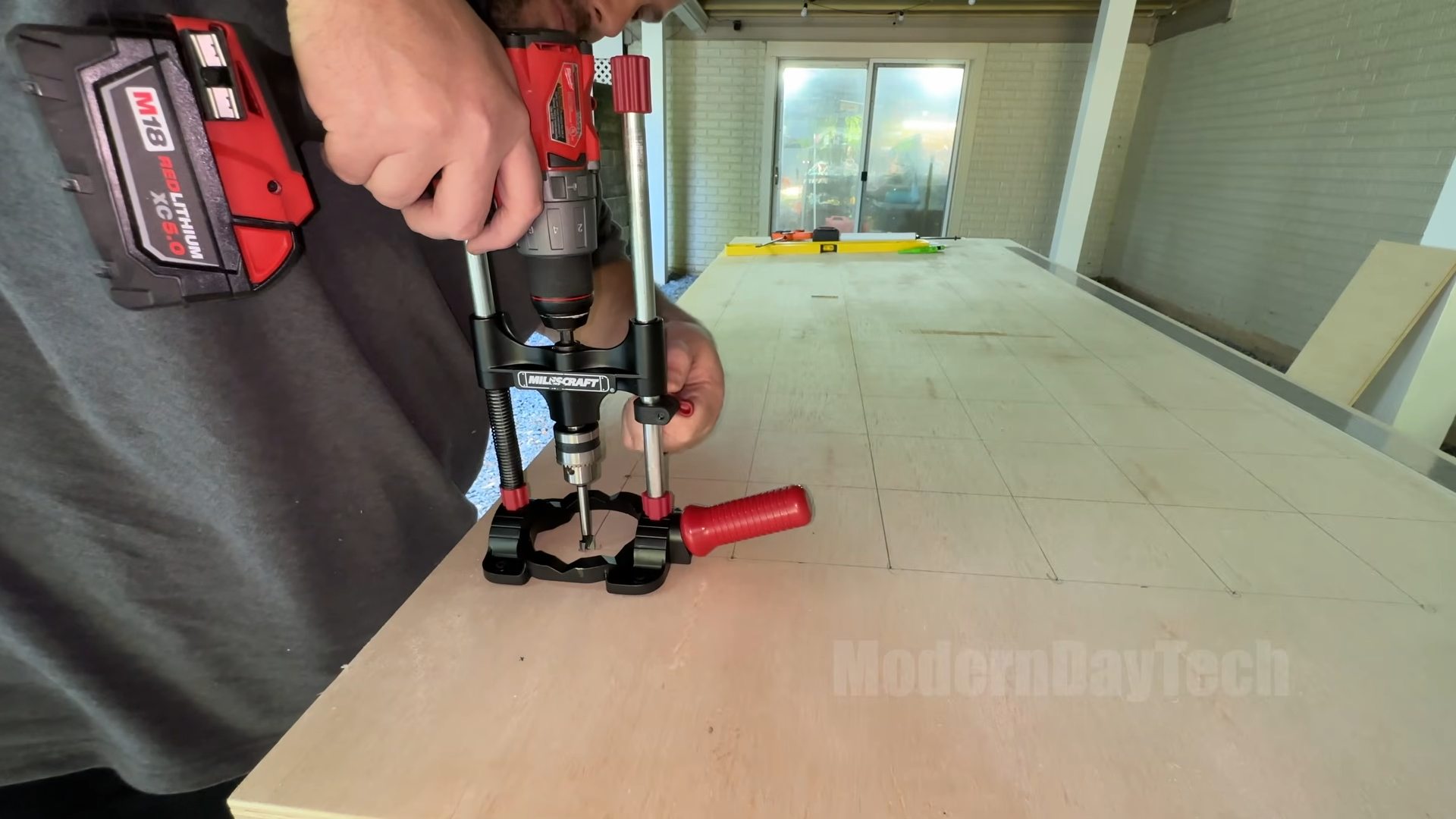
One hole freehand? Fine. Ninety-eight of them, all straight, all the same depth, all evenly spaced for something like a donut wall? That’s where a freehand drill starts drifting and you start noticing. That’s the exact job the Milescraft DrillMate Portable Drill Guide Adjustable Precision Drilling Jig is built for.
The idea is simple. Your cordless drill mounts into the guide’s 3/8″ chuck, the guide rides on rods, and the drill can only travel in one direction: straight down the line you set. Lock it at 90 degrees and every hole is perpendicular whether it’s hole one or hole ninety-eight. The adjustable depth stop handles the other half of the problem, so you’re not blowing through the back of a board because you leaned a little harder on number sixty.
And you’re not limited to flat panels. The base self-centers on round stock up to 3″ in diameter, which is the part most people overlook. Drilling a dowel or a closet rod dead-center freehand is a coin flip. Here it isn’t.
Four angles, and only four
45, 60, 75, 90. Those are your options with this drill guide adjustable setup, and each one locks. Great for repeatability, less great if your project calls for 30 degrees or something in between. There’s no infinite adjustment here, so know that going in.
The other limit is the one the name gives away: portable. This is a guide, not a press. There’s no column, no cast-iron table, no quill lever giving you mechanical advantage. You still supply the downward pressure, and in hardwood or with a large bit that’s real work. A drill press also gives you a table you can clamp to. Here, the DrillMate sits on the workpiece, so anything that shifts under it shifts your hole.
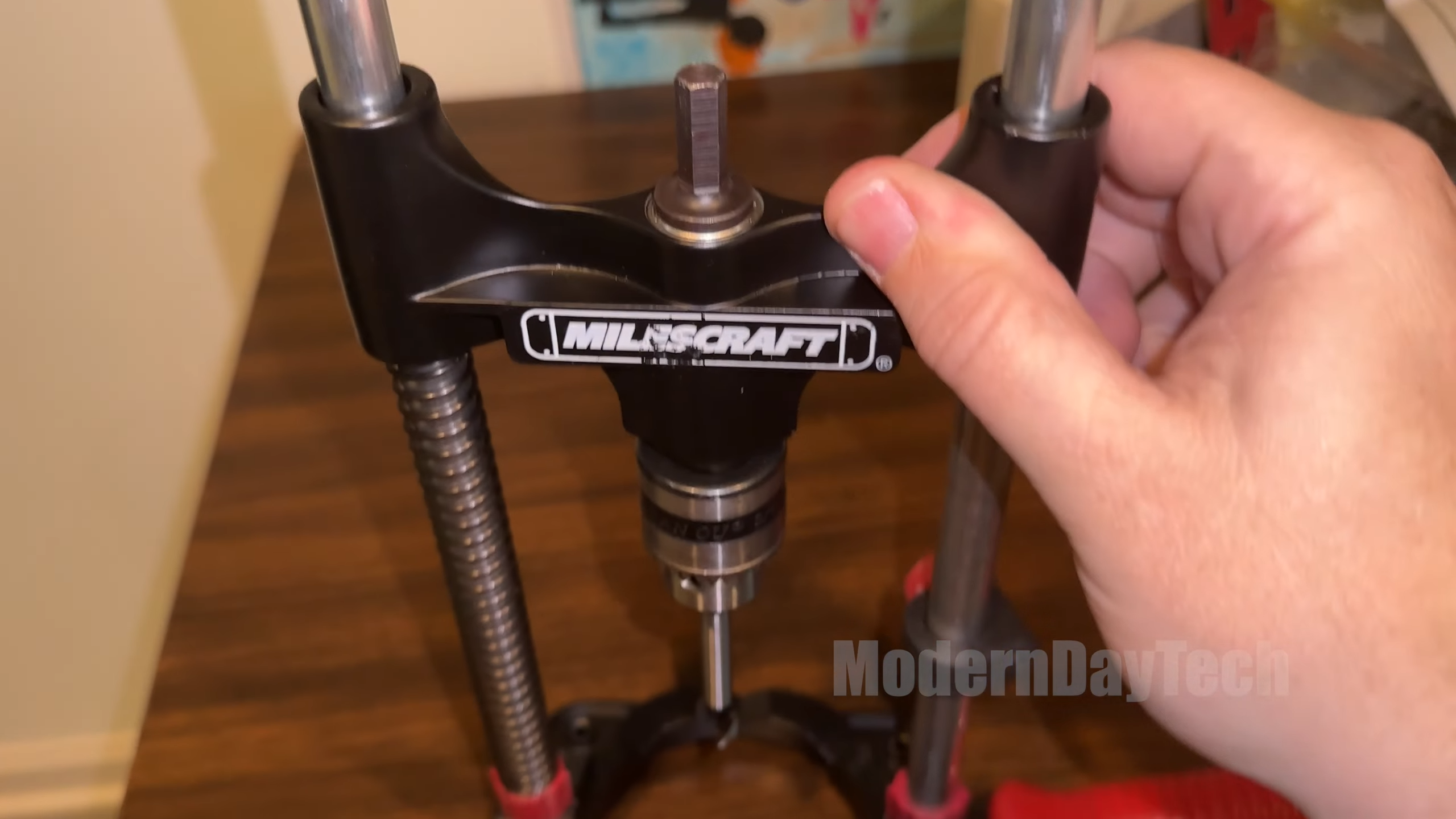
The 3″ round-stock ceiling matters too. Fence posts, thick table legs, anything beyond that, and the self-centering base has nothing to grip.
What the drillmate drill guide costs you versus a benchtop press
A benchtop drill press starts around $150, weighs 30-plus pounds, and claims a corner of your shop permanently. The DrillMate fits in a toolbox drawer and goes up a ladder. If you’re drilling dozens of holes a few times a year rather than running production work, that trade is obvious, you’re not giving up much precision for the jobs this tool is actually designed for.
One thing worth knowing before you click buy: this thing’s price swings, and the delta matters on a tool at this price point. It has sold meaningfully cheaper than its current level in the past, so check the live price, if it’s at or above its three-month high, waiting a few weeks has historically paid off. It’s also moving volume, over a thousand sold in the past month and sitting around #8,390 in Tools & Home Improvement, which for an accessory this specific is a lot of people buying the same fix.
Before you order one
Check your drill’s chuck size first. The DrillMate attaches to 3/8″ and 1/2″ cordless drills, and that covers most of what people own, but verify before you order. The included chuck is 3/8″ capacity with a key, so oversized bits above that aren’t going in.
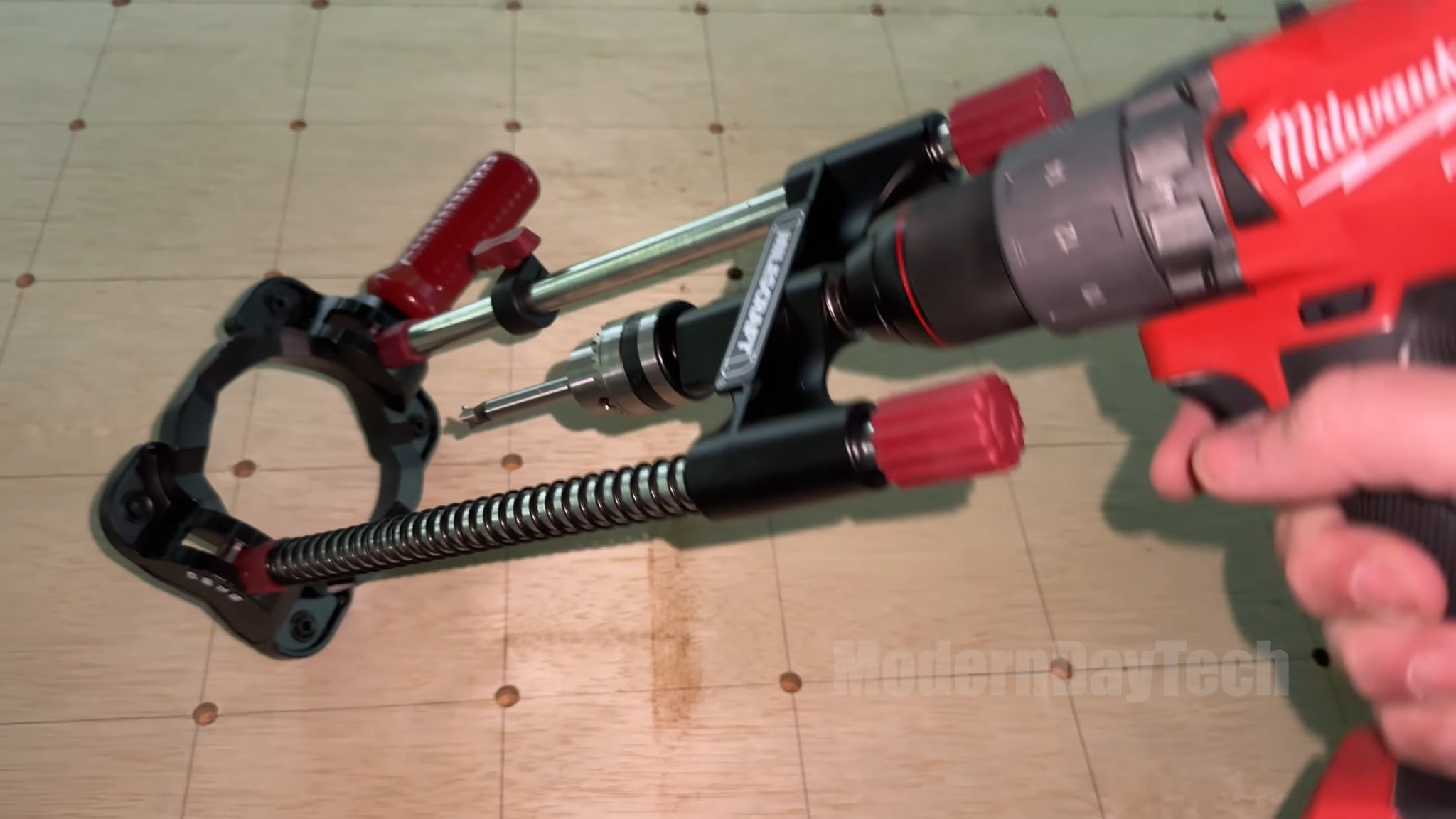
The detail that gets missed: the rubber feet come off. Pull them and you can mount the DrillMate to a board or a fixture and build a permanent repeating jig. If your project is production-style, that’s the feature to plan around from the start rather than discovering halfway through.
Pros
- Four locking angle stops at 45, 60, 75 and 90 degrees, each repeatable
- Adjustable depth stop prevents drilling through the back of a workpiece
- Self-centering base handles round stock up to 3″ diameter
- Fits 3/8″ and 1/2″ cordless drills, includes a keyed 3/8″ chuck
- Removable rubber feet let you mount it as a permanent jig
Cons
- Only four fixed angles, no continuous adjustment in between
- No leverage assist, all downward force comes from you
- Round stock over 3″ is out of range
- Price fluctuates a lot, so buying at the wrong moment costs you
Frequently Asked Questions
Can it drill into a wall or the edge of a board?
Yes, both. Milescraft lists edge-of-board and wall drilling as supported uses alongside flat-surface and angled work. The base is what makes edge drilling possible, since it registers against the stock instead of needing a flat table underneath.
Do I need to buy a separate chuck key?
No. The 3/8″ capacity chuck ships with its key included. Keep it somewhere attached to the tool, because a keyed chuck with a missing key is a paperweight.
Will it work with a corded drill?
Milescraft specifies 3/8″ and 1/2″ cordless drills, full stop. A corded drill with a matching chuck collar may physically mount, but the extra cord weight and bulk can introduce the same wobble you bought this guide to eliminate, if you’re primarily using a corded drill, a benchtop press is the better fix.
Clicking takes you to Amazon. As an Amazon Associate we earn from qualifying purchases — pricing and availability subject to change.
Get it now
Milescraft DrillMate Portable Drill Guide
Get the best price on Amazon →Affiliate link. See the disclosure at the top of this post.